

Imagine you’re leading a ship through unpredictable conditions. The crew’s skills, confidence, and motivation all affect whether the team can reach its destination. In business, managers face the same challenge: people need different kinds of support to do their best work.
The skill will matrix gives managers a practical way to match coaching to an employee’s ability and motivation for a specific task. It can help you develop eager learners, re-engage skilled employees, set clear expectations, and give high performers room to lead. Use it as a starting point for a conversation—not a permanent rating of a person.
What Is the Skill Will Matrix?
The skill will matrix is a coaching framework that compares two factors: a person’s skill for a particular task and their current will or motivation to do it. Skill includes relevant knowledge, experience, confidence, and demonstrated ability. Will can reflect interest, energy, commitment, and the conditions around the work.
In this guide, skill runs from low to high on the horizontal axis, while will runs from low to high on the vertical axis. Some organizations call these dimensions capability and commitment, and coaching labels can vary across models. The practical goal is consistent: understand what is affecting performance and choose support that fits the task. Use the skill will matrix as a conversation guide rather than a permanent label. The MindTools Skill/Will Matrix overview describes alternate names for the four coaching approaches.
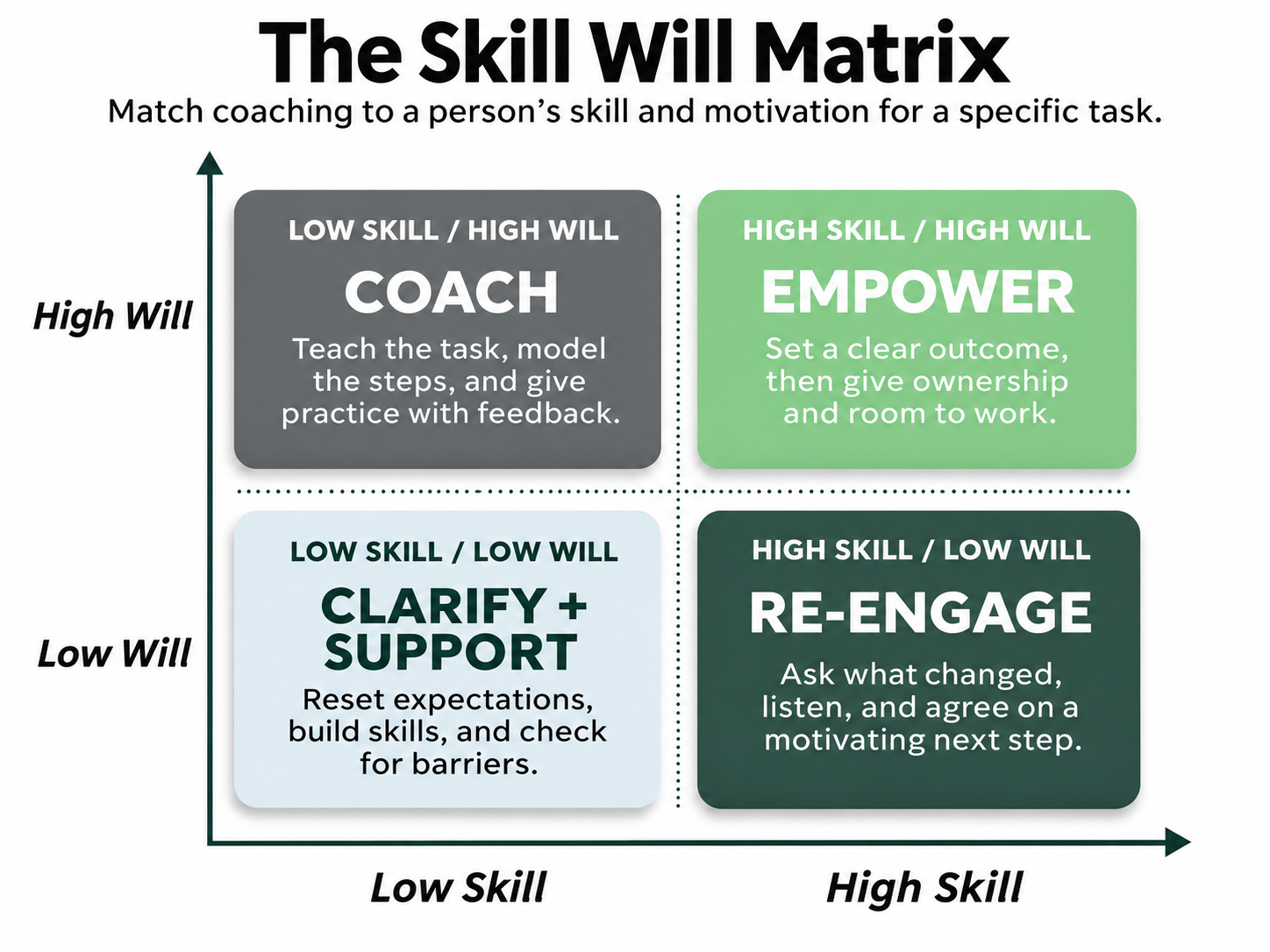
The Four Skill Will Matrix Quadrants
Each quadrant suggests a different management response. A person may sit in different quadrants for different responsibilities, so assess one task at a time and confirm your observations with the employee.
Low Skill, High Will: Coach the Eager Learner
This employee wants to succeed but has not yet built the skills or experience needed for the task. Give clear instruction, demonstrate the steps, provide useful resources, and create time for guided practice. Break a complex assignment into smaller milestones and give specific feedback as the person improves.
For example, a new team member may be enthusiastic about preparing a monthly report but unfamiliar with the company’s data tools. Pairing them with an experienced colleague, sharing a checklist, and reviewing the first few reports can build capability without damping their motivation. Set a date to check progress and reduce support as the person becomes more confident.
High Skill, High Will: Empower and Retain
When an employee can do the work and is motivated to contribute, focus on outcomes instead of directing every step. Agree on priorities, deadlines, and decision limits, then give the person autonomy to choose how to deliver. Recognize meaningful contributions and offer stretch assignments that build leadership or mentoring skills.
High performers still need useful feedback, fair access to opportunities, and a path to grow. Regular career conversations can help you understand what challenges them and what might encourage them to stay. Empowerment works best when the employee has the authority and resources needed to meet the expectations you set.
Low Skill, Low Will: Clarify Expectations and Support
This combination calls for a calm, direct conversation—not a label. First confirm that the employee understands the task, quality standards, and priorities. Then ask what is getting in the way. The issue could be missing training, low confidence, unclear direction, competing work, limited resources, or a mismatch between the assignment and the person’s strengths.
Agree on a practical support plan with clear expectations, measurable next steps, and a review date. That might include a demonstration, a practice assignment, a job aid, or more frequent check-ins. Document the goals and support provided. If performance remains below expectations after a reasonable opportunity to improve, follow your organization’s established performance process.
High Skill, Low Will: Re-Engage the Skilled Employee
A skilled employee who seems less engaged may be facing unclear priorities, repetitive work, workload pressure, limited autonomy, or a change in personal or professional goals. Ask what has changed, listen without jumping to conclusions, and recognize the expertise the person brings. A private conversation is more useful than assuming low motivation means a lack of commitment to the whole team.
Then work together on a focused next step. You might remove a barrier, involve the employee in a decision, adjust an unrealistic workload, or offer a challenging assignment aligned with their interests. Agree on what progress should look like and when you will review it. If you make changes, check whether they actually improve engagement and results.
How to Use the Skill Will Matrix With Your Team
- Choose one task. Avoid judging someone’s overall value from one project. Define the result, quality standards, and deadline before assessing skill or motivation.
- Use evidence, not assumptions. Review recent work, accuracy, follow-through, relevant experience, and the employee’s own view. A manager’s impression of motivation may be incomplete.
- Discuss the situation together. Ask open questions about confidence, training, workload, priorities, and barriers. Invite the employee to describe what support would help.
- Choose one or two actions. Match support to the need: coaching, practice, clearer direction, recognition, a barrier-removal conversation, or more autonomy.
- Set a follow-up date. Track agreed measures such as quality, completion time, customer outcomes, or skill milestones. Reassess when the task or evidence changes.
Keep notes focused on work behaviors and agreed goals. The matrix works best as a development tool that helps managers respond thoughtfully, rather than as a scoring system used to rank employees.
A Practical 90-Day Coaching Roadmap
A 90-day plan gives a manager and employee time to clarify the challenge, try relevant support, and review progress. Adjust the timing to the task; the dates are checkpoints, not a guarantee that every skill gap or engagement issue will be resolved in three months.
Days 1–30: Assess and Agree on Priorities
Select one or two important tasks, define what successful performance looks like, and gather examples of recent work. Have a confidential conversation about the employee’s perspective, then agree on a small number of goals and the support needed. For a skill gap, that may mean a mentor, a training resource, and a first practice assignment.
Days 31–60: Coach, Practice, and Remove Barriers
Put the plan into practice. Provide the promised resources, schedule brief check-ins, and give timely feedback based on observable work. If motivation is low, follow up on barriers and changes the manager agreed to make. If the employee is ready for more independence, increase ownership while keeping the outcome and decision boundaries clear.
Days 61–90: Review Results and Adjust
Compare results with the goals you set. Ask what improved, what remains difficult, and which support was most useful. Update the coaching plan and next milestones. A person may move to another quadrant as experience, task demands, workload, or motivation changes.
Use the Skill Will Matrix Fairly
Do not treat the quadrants as permanent types or sort employees into “A,” “B,” or “C” players. Fixed labels can hide context and discourage development. The matrix also does not prescribe a percentage of people who should fall into each group; assess the evidence in your own team.
Use consistent, job-related expectations and consider whether employees have had comparable access to training, feedback, time, and resources. Motivation can be affected by conditions at work, so ask before you infer. Revisit your view when a task changes, the employee develops, or new information emerges. The University of South Australia’s development conversation guide also presents the matrix as a way to match a manager’s approach to a staff member and task.
When a skill gap involves workplace technology, structured team training or Microsoft 365 training can provide guided practice that supports a development plan.
Frequently Asked Questions
Is the skill will matrix the same as the capability-commitment matrix?
The terms are often used for related coaching frameworks, but sources may define the axes and actions differently. In this article, skill means task-specific ability, and will means current motivation or willingness to do that task. Check the labels on the matrix you use and discuss the interpretation with the employee.
How often should managers reassess an employee?
Reassess when the task changes, new performance evidence appears, or the employee has had time to use the agreed support. During an active coaching plan, brief check-ins and a more formal review around each milestone can keep the plan relevant.
Can an employee move between the four quadrants?
Yes. Skill can grow through instruction and practice, while motivation can shift with workload, clarity, support, confidence, and priorities. Assess the person in relation to the task and current conditions rather than treating a quadrant as a lasting description.
Build a Team That Can Keep Growing
A high-performing team is not built by managing everyone the same way. Use the skill will matrix to understand what a task requires, ask each employee what is affecting their work, and agree on a practical coaching response. With clear expectations, useful training, appropriate autonomy, and regular follow-up, managers can help employees develop their skills and contribute with confidence.
Which situation is most challenging on your team right now: coaching an eager beginner, re-engaging skilled talent, clarifying expectations, or empowering a high performer? Share your experience in the comments or pass this guide to a manager building a stronger team.